It Was Just Another Flight—Until Everyone Notice
It began like most journeys do.
Seats filled. Bags tucked away. Conversations faded into the low hum of an aircraft preparing to move.
No one expected anything unusual.
It was meant to be ordinary.
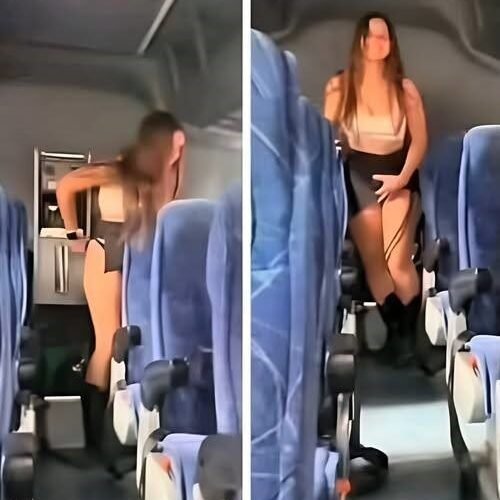
The cabin looked the same as always. Narrow aisles. Rows of identical seats. People settling into temporary routines beside strangers they might never see again.
She was one of those strangers.
Anonymous. Unremarkable. Just another passenger trying to get comfortable before takeoff.
Public spaces carry quiet rules.
Unwritten expectations about how to behave, where to look, what to ignore. Airplanes amplify those rules. There is nowhere to go, nowhere to turn away.
At first, nothing felt out of place.
People adjusted headrests. Flight attendants moved through the aisle with practiced calm. The familiar choreography of travel continued.
Then a moment stretched longer than expected.
It wasn’t loud.
It wasn’t aggressive.
It was simply unexpected.
A pause. A movement. Something that didn’t quite fit the rhythm of the cabin.
A few heads turned.
Not because anyone wanted to stare, but because uncertainty naturally pulls attention. People look when they don’t understand what they’re seeing.
She stood briefly in the aisle, adjusting herself, perhaps unaware of how visible the moment had become. Or perhaps aware, but unsure how to recover quickly.
In public spaces, hesitation can feel louder than action.
No one spoke.
No announcement followed.
The cabin remained quiet, but the silence changed shape.
Passengers are trained, in small ways, to mind their own business. To avoid involvement. To pretend not to notice discomfort that isn’t theirs.
So most people looked away.
But looking away doesn’t erase what was seen.
It only delays interpretation.
Someone lifted a phone.
Not dramatically. Not openly. Just enough to capture a fragment of the moment before it passed.
The flight continued.
That is how many stories begin now—not with an event, but with a recording.
Later, far from the cramped rows of seats, the image traveled. Stripped of context. Detached from the confined space and the pressure of being observed by dozens of strangers.
Online, the moment became something else.
Speculation replaced uncertainty.
Judgment replaced silence.
Certainty replaced the uncomfortable truth that no one really knew what was happening.
Was she unaware?
Was she distressed?
Was it a misunderstanding amplified by the unnatural closeness of the cabin?
The image didn’t answer those questions.
It didn’t try to.
It simply froze a human moment in the most unforgiving way possible.
Public mistakes—if this even was a mistake—used to dissolve with time. They were remembered vaguely, then forgotten. But now, they persist. Replayed by people who were never there.
Airplanes are strange environments.
They compress people physically and emotionally. Fatigue, anxiety, and unfamiliarity collide thousands of feet above the ground.
Small lapses can feel enormous.
And once a moment leaves its original setting, it no longer belongs to the person who lived it.
Online, reactions came quickly.
Some were mocking.
Some were moralizing.
Some pretended concern while feeding curiosity.
Very few acknowledged how fragile the boundary is between composure and exposure.
Most people have had moments they hope no one remembers.
A stumble.
A lapse in judgment.
A second where their internal world leaked into public view.
The difference is that most of those moments weren’t recorded.
This wasn’t a story about wrongdoing.
It wasn’t a story about spectacle.
It was a story about how easily discomfort becomes content.
The aircraft landed.
Passengers dispersed into different cities, different lives. For most, the moment faded into the background noise of travel.
But for one person, it followed her.
The image did what images often do—it simplified.
It reduced a complex situation into something easily consumed.
And in doing so, it erased context.
There was no room left for exhaustion.
No space for anxiety.
No allowance for the possibility that the moment was more vulnerable than provocative.
When people talk about privacy, they often imagine closed doors and locked screens. But privacy is also situational. It depends on grace. On restraint. On the collective decision to let something pass.
That decision is becoming rarer.
We live in a time where noticing something is often treated as permission to share it. Where presence is mistaken for entitlement.
This wasn’t about the aisle of a plane.
It was about how quickly human discomfort becomes public property.
The most striking part of the image wasn’t what she was doing.
It was how ordinary the space was.
An airplane seat.
A narrow aisle.
A moment anyone could imagine themselves standing in.
Nothing about it suggested it would last beyond a few seconds.
Nothing suggested it would be replayed by people far removed from its reality.
And yet, here it is.
Some moments don’t announce themselves as important.
They happen quietly, then expand long after they’re over.
Not because they mattered more than others—
but because they were seen, captured, and carried somewhere they were never meant to go.